A blog by Gordon & Laurie Schremp
My wife and I have been active hikers and birders since 1998, mostly throughout California, SE Arizona, and various South America destinations. After visiting New Mexico for more than 20 years we decided to retire to Albuquerque adjacent to the Petroglyph National Monument during the summer of 2022. Having participated as team leaders on four northern California Christmas counts we wanted to continue that citizen science in our new home. The relatively new Hillsboro count allowed us to help out in a remote portion of the state with resplendent scenery and diverse high-desert ecosystems that increase the odds of sighting unusual species.
The history of the Audubon Christmas bird count dates to Christmas day, 1900, when 27 participants in 25 locations documented species and numbers sighted that day. Nearly all of those locations were east of the Mississippi River with the exceptions of Pacific Grove, CA and Pueblo, CO. An ornithologist by the name of Frank Chapman is credited with championing the switch from Christmas day bird hunting competitions to bird counting competitions. The switch caught on and has spread outside the borders of the United States to over 20 other countries. The primary purpose for these annual counts is to track the species diversity and total numbers over time to better understand changes to avifauna populations. Each count “circle” is 15 miles in diameter and participants endeavor to identify and tally all of the birds sighted, and even heard, from dawn to dusk. Some participants start even earlier or continue birding after sunset to document the presence of owls, nightbirds and other nocturnal species.
The 125th annual CBC ran from December 14 to January 5. There were 2,693 count circles spread over 21 countries. The 83,109 participants documented 2,503 species and 44,259,423 total individual birds. Take a look at the Audubon link to see which count circle is closest to your home. For a deeper dive, the Audubon Society also has links to writeups for each of the counts. The earlier publications are quite interesting.

Our third Hillsboro CBC began with a gorgeous sunrise prior to ascending Horse Thief Pass from SR 27. The SW route commenced at the intersection with Conesco Trail Road, paralleling Berrenda Creek, until reaching the old Berrenda Ranch structures. Due to the extremely dry conditions, absence of visible water, and low bird numbers viewed during the prior afternoon’s scouting mission, we anticipated less diversity and lower individual numbers than the 2024 count. Within a couple of minutes those concerns were dispelled by dozens of juncos and sparrows emerging from the riparian cover, interrupted by a Red-Naped Sapsucker. Sparrow diversity increased as we neared the old ranch with Brewer’s, Vesper, Song, Savannah, Black-throated, Sagebrush, and House (I know, it’s still a countable species) joining the party. Unfortunately, there were no thrashers or Chickadees that were encountered in 2024.
Rejoining Berrenda Road (county road B003), we headed for the Gila National Forest boundary via county road B116. Stopping at a dry mud remnant of a cattle pond in a small ravine, we were pleasantly surprised to see six Black-throated Sparrows pop up in response to my pishing. Continuing on, the road took us back down towards Berrenda Creek where we briefly halted at an old steel tank with a variety of shrubs and stunted trees. A shy, but briefly inquisitive Lincoln Sparrow made an appearance before dashing away. But we struck out on Loggerhead Shrike and Rufous-crowned Sparrow that had been picked up the previous two counts.

After recrossing the dry wash of Berrenda Creek, we approached the canyon entrance to the south of Schoolhouse Mountain. The bird activity immediately picked up with the increased cover on both sides of the riparian corridor. We exited the jeep, leaving it temporarily parked in the middle of the road since all of the land on either side of the road leading up to the entrance of Gila National Forest is private and cannot be traveled upon to avoid trespassing. Not to worry though, plenty of avifauna to be viewed on foot from the road! A mixed flock of Juncos and Sparrows (Chipping & White-crowned) was joined by a couple of Bridled Titmice, a dozen Western Bluebirds, Ruby-crowned Kinglets, Spotted Towhees, Hermit Thrush and a Hutton’s Vireo.
Always on the lookout for something out of the ordinary while out on a count, we sighted a larger warbler-like individual initially foraging in a juniper. I briefly saw some yellow and a flash of wing bars before raising my camera to try and capture some images. Within 15 seconds the bird flew off without the chance to view with my binoculars. Laurie called out from up the road and said she had a warbler in view for less than a minute. Before I even had a chance to review my photos to see if I could make an ID, a warbler alighted in a deciduous tree about 20 feet from me with the sun at my back (perfect viewing conditions). I immediately recognized its unusual plumage and briefly panicked that it would scoot before I could get a few photos. Fortunately, the individual stayed in place for at least a minute enabling me the opportunity at some quality shots. Only after it departed did I review my pictures, then walked up the road to tell Laurie that we were going to need to fill out a rare bird report for the female Olive Warbler!
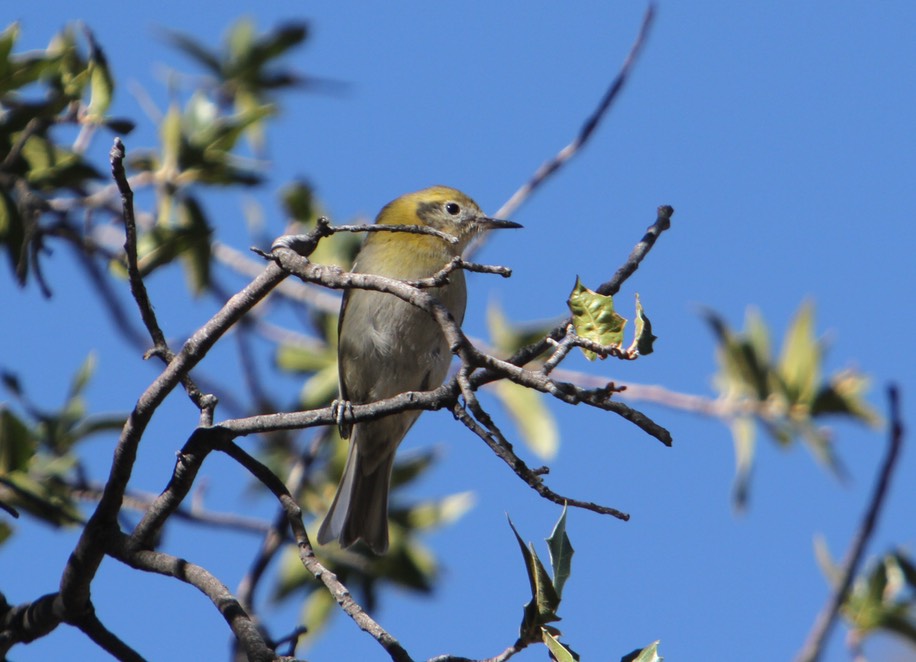
Laurie and I have seen Olive Warblers before on a half dozen occasions, mostly in SE Arizona at high elevation. For anyone else who has had a chance to view this species, the experience usually consists of a single bird at the tippy top of a pine tree at around 8 or 9 thousand feet elevation. The count view was by far the best look either of us have had to date. By the time we reached the Gila national forest boundary, we had traveled 4.8 miles and observed 36 different species.
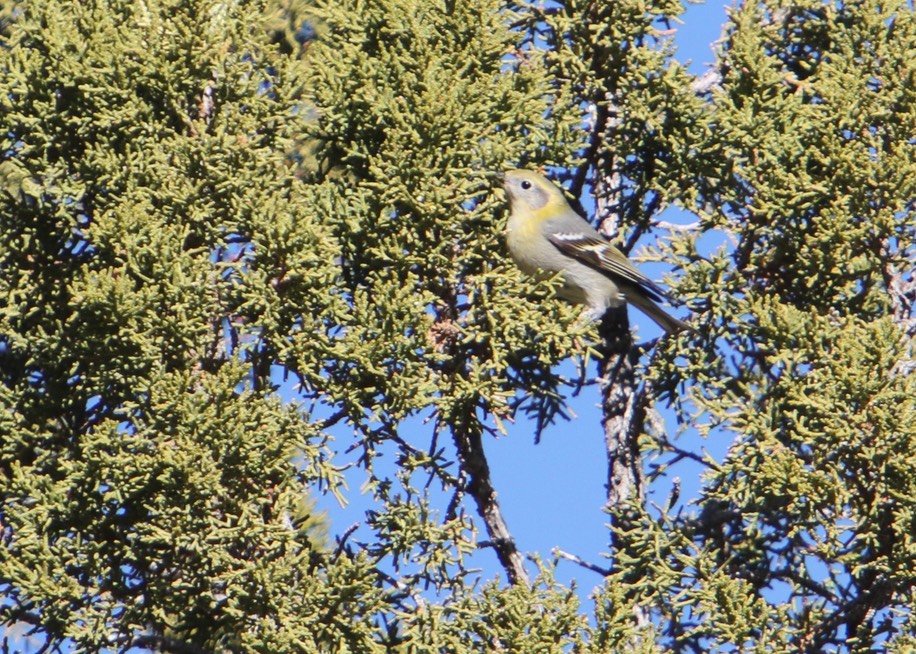

Olive Warbler is not part of the Wood Warbler family, rather a species now considered as the sole member of the Peucedramidae family. During the breeding season Olive Warblers inhabit forested areas above 6,000 feet that contain various pine tree species that are used for nesting. According to the Sibley range map, Olive Warblers migrate out of the United States into Mexico greatly reducing the probability of a Christmas bird count encounter except in SE Arizona. So one would assume that the individual we sighted was highly unusual.

According to Cornell Labs, the majority of Olive Warblers that breed in the United States are likely to be permanent residents or migrate a very short distance usually to a lower elevation during the winter months as depicted by their range map. So how unusual was this sighting for the SW portion of the Hillsboro CBC if many of the Olive Warblers move to lower elevations in the same area to hang out in mixed flocks? One measure would be to see the relative abundance of this species during the middle of December based on weekly eBird data for the period 2009 through 2023. Each grid will show a numerical representation of how many individuals of a specific species would be viewed by an expert birder during a one-hour period over a 2-kilometer track during the peak time of day. For example, viewing the weekly abundance of Dark-eyed Junco reveals that their score would be between 6.5 and 8.5 individuals for the grid that Laurie and I were birding for the middle of December. By comparison, the abundance score for Olive Warbler at the same location and for the same day is listed as 0.00.

The location of our Olive Warbler sighting (red star) is just outside the Gila NF boundary. The closest abundance grid is approximately 3 to 4 miles to the west of our position with a rating of 0.04. That means an expert birder would have to bird that grid area 25 times to eventually sight a single Olive Warbler. This abundance resource from eBird is a very useful tool to identify locations that provide a greater probability of viewing a particular species of interest either on a specific week or throughout the year.
And now for the rest of our day…The second leg of our outing involved a 5-mile roundtrip hike from just inside the NF boundary (designated by a green gate). More of the same from the first leg with a couple of new species (male Northern Harrier & Bushtits). On our way back either over the same route or off to the other side of the canyon it is always a judgment call regarding tallying any additional individuals of species already sighted on the outbound leg of the hike. Best approach is to stay conservative and only add to the count if you encounter a group larger than previously seen, then go with that higher number. Single individuals that stay in a relative small location can be a new bird if the new location is at least half a mile or more from the original sighting.
The final leg of our journey had us retracing the roads all the way back to the old Berrenda Ranch property. Along the way we picked up a Sharp-shinned Hawk that moments before caught what appeared to be a Pink-sided Junco. Still no Shrike or Rufous-crowned Sparrow. We like to stop by the old ranch in the later afternoon to see if any additional species are present or flocks larger than encountered in the original morning stop. As such a single American Robin and 7 Red-winged Blackbirds were new for the day, along with a larger flock of Brewer Blackbirds (64) than previously sighted in the morning (26). One final new species (Say’s Phoebe) presented prior to our reaching the intersection with Horse Thief Pass Road around 4:15 PM. Final count to another splendid CBC outing was 43 species over 9 hours with 9 miles of driving and nearly 6 miles by foot. Can’t wait ‘til next year!